Showing posts with label Technology. Show all posts

Thursday, February 1, 2024

Tech Paradigms in the Grand Cluster

The Grand Cluster , the setting for Called from Exile, hosted a wide variety of technology: almost the entirety of the ultra-tech book exists in there somewhere. But I didn't want characters to be using all of it, because the point was to have lots of homages to various science fiction settings next to each other and interact with each other, and I wanted the PC's to feel that.

So the base TL was 10, but access to most technology had to be purchased with "technology points". These didn't raise player's Tech Level so much as control what genre of science fiction they could buy gear from. I let them choose a ranged weapon class for free (lasers is a class, slug throwers is another, force beams is another), as well as a specifying what their typical comms/computer interface looked like. For most other PC-style gear, they needed to select options with technology points. This was a player decision, but it was about their home culture as much as it was about them.

Wednesday, April 13, 2022

PaverGuard Striders

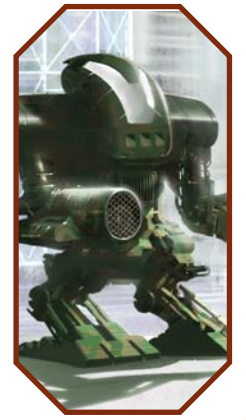
Paverguard creates not only the most popular series of battlesuits in the xenospiral edge of colonized space, but heavier walkers as well. While their battle-suits keep you safe, their Striders allow you to exterminate the vermin that threaten your home!

Earlier, I wrote a post detailing a bunch of power-suits for use in a TL10 frontier setting with hostile alien beasts. In this post, I will be building the next step: TL10 combat walkers. These will be built using the method described in Walkers and Power Armor. 

Paverguard's strider series are quite a bit lighter than true mecha, but are still quite heavy and have cockpits rather than being mere suits, providing a huge strength boost and heavy armor. At weights below 3,000 lbs or so, Paverguard recommends its signature battlesuit line. (That's the natural point at which this armor method begins to be more effective than the battlesuit formula)

Thursday, December 2, 2021

Robots as Spaceships: Paver-Guard Battlesuits

On the rim of civilized space, there are monsters. Alien beasts of every description imaginable. Some are hostile and irritable. Some are fearless and stealthy predators. Some are driven by strange hive-mind bent on destroying human habitation. Don't rely on exterminators to keep you safe. They will avenge you, but if you want to stay safe, you'll need Armor. Armor like PaverGaurd. 

I've talked about creating power suits and walkers in earlier posts, but I really only made one. Here I present a spectrum of TL 10 battlesuits of all sizes.

Thursday, November 18, 2021

Robots as Spaceships: Battlesuits Revisited


Earlier, I wrote a simple method for making custom sized powered armor in Gurps:

After you build the armor with the right DR, add 50% more weight to the armor, and you have a suit of powered armor. Look up the strength based on its weight here

Basing the cost of the system on the additional weight is fine for most of the armors given in those pyramid articles. The "true" cost is $70 per pound of added weight with no leg or arm cost reductions.

The problem is... this system doesn't scale properly. Armor up to about 150 lbs worked out right, but once that was passed, the battlesuits got better and better for their weight class, and posted incredible DR's, like a half ton suit of armor giving almost 450 DR at TL10!

I noticed that this weight of 150 lbs was the point at which the weight of the armor began to be larger than the weight of the wearer, and calculated a new formula for battlesuits weighing 150 lbs or more (which to be fair, is most of them). 

DR = Weight^(1/3) x 3.5 x TL DR Factor

The TL DR Factor is 3 DR at TL 9, 5 DR at TL 10, and 7 DR at TL 11*. Cost per pound of the armor is $1 times its base cost. 

*This is the same number as for 7.5 lbs of armor talked about in the article being updated.

With this new system, the battlesuits outperform the walkers in terms of DR until about the 1.5 ton mark... which is perhaps a bit higher than we wanted, but isn't a bad number.


Thursday, April 15, 2021

Robots as Spaceships: Walkers and Power Armor

So what is the difference between a combat walker and power armor? They seem to be a simple continuum starting with simple armor that strengthens the user and ending with giant mecha. Its not that simple though, and the more I've worked on making power armor and walkers work in Robots as Spaceships, the more distinct the two things become.

  • Power armor is worn, Walkers are piloted. 
  •  Power Armor only needs to bear its own weight and not get in its bearer's way. Walkers need to bear the weight of the pilot.
  • Power Armor must have its knees, elbows, shoulders, and hips in the same location as its wearer. Walkers can have these locations in the same places, but often do not.

Of course, art breaking that last rule is not exactly uncommon, but we can call that cinematic, and judge if it is a walker or power armor on a case by case basis.

Thursday, March 11, 2021

Metatronic Generators In Low Tech Settings


Historically, I've always looked at Metatronic generators funny. They provide a direct translation from points to cash, and that often gives funny numbers. The base version also has this weird assumption that you will be using electricity baked into it, and they're generally based off of Psychotronics, which are intentionally an area of weirdness. 

 I just realized that I'm using them for a TL1 fantasy game.

Not intentionally, but the more I look at the "Magic System" the players have access to, the more I'm convinced that it can be usefully expressed in terms of Metatronic generators. So what's the system, and what settings do I use to make Metatronic generators useful at TL1?

Wednesday, March 3, 2021

Robot Brains: The Skill Budget Model

In Gurps, perhaps the simplest way to give AI's skills to give them skills for being functioning minds. Which is to say, just like any other character. The skills are an intrinsic part of who they are. They can learn new skills the same way any other mind does, by studying, practicing, and through hands on experience. They can no more download a new skill than a human can purchase one in the form of a book. 

Friday, February 26, 2021

Robot Brains: Skills as Software

In our last post, we talked about limiting the ability of AI's to buy skills. Now that we've done that, we still need to know how much those skills will cost. There are two basic approaches: Buying skill levels, and buying skill points.

Wednesday, February 17, 2021

Robot Brains: The Limits of Purchased Skills

Artificial intelligence links two mostly unrelated parts of Gurps: Character points and Wealth. While skills can often justify wealth, and fancy tools can give a few mild bonuses or cancel enormous penalties, Artificial Intelligence almost demands that we stick a price tag on specific skill levels.  Without additional limits purchasing skill with money can warp a game very quickly. 
 
Fortunately, in most settings, such additional limits exist. Software doesn't just pop into being out of nowhere, and not all software works for all hardware or all operating systems, and installation of new software isn't instant and painless. 
 
Placing these sorts of limitations has a few welcome effects. They reduce the power of wealth and set a social baseline for what the players can expect. If most robots can only get riffle-14, but such robots are cheap, Players know what to prepare for, and establish their skill of 13 as workable but nothing special. These limits also make space for the exceptional. When the PC's run across a robot with riffle-16 instead of riffle-14, they will take note and at least wonder why this robot is special. It will let them know why they are considered elite, and what they need to accomplish to become elite in something else.
 

Thursday, April 30, 2020

Robots as Spaceships: Flyers

Not all robots are bound to the ground or to the water. Some of them can fly! Here we look at the various options Gurps: Spaceships provides for atmospheric locomotion.  Some options we might want are missing: propeller systems are the most notable. Others we want to adjust the stats on a little, and still others we just want to understand properly. Most of the time we will be adjusting speeds down in the name of modeling real or fictional vehicles: the new lower speed we call "Downshifted".

While this article is part of robots as spaceships, its probably just as useful when building vehicles, and I suspect I'll come back to it more in that context than for robots.

Saturday, April 18, 2020

Robots as Spaceships: Quadcopters

In the last decade or so, consumer robotics has aquired an all star: the Quadcoptor. When we talk about a drone now adays, we're almost always talking about a quadcopter. Perhaps no robot has ever been produced in such numbers and made so available to the public.

In our Robots as spaceships system, this just means we need to use the helicoptor rotors from Spaceships 7, right? Well, we could. But quadcopters don't have the same performance as real helicoptor rotors, and they have very different costs and mechanics. They don't cost the same amount, and they don't move in the same way. Quadcopters use a very different steering mechanism from traditional helicopters. Helicoptors steer mechanically using "swashplates", while quadcopters vary their power to different propellers. The Quadcoptor method is more difficult to pilot and less power efficient than a true helicopter. Its also much simpler and cheaper to produce, and with modern electronics, piloting it is no longer a major issue.

So lets build a system for quadcopters in spaceships.

Wednesday, March 25, 2020

Robots As Spaceships: Swimmers

As a sequel to terrestrial motive systems, we will be looking at aquatic motive systems. This time, we will be looking less at cost, and more at speeds when using small size modifiers. We will be inspecting Ballast Tanks, Underwater Screws, Surface Screws, and Flexibody Drive-Trains. All of these systems are from Pyramid #3/34

Saturday, March 14, 2020

Robots as Spaceships: Terrestial Motive Systems

There are many jokes about physicists and frictionless vacuums. Space is the rare environment that is a frictionless vacuum, and that makes calculating spaceship movement strangely simple, if foreign to those accustomed to terrestrial movement. When on the ground, a host of forces acting on a vehicle create a complex environment to move through.

A complex environment many of us have an intuitive grasp of, and we notice when things are a bit off. We plan to use Spaceship's Motive systems in a lot of our robots, and its worth tweaking a few of the numbers.

In this article, we'll be looking at tracks, wheels, and legs, the simplest and most common motive systems for robots in fiction (along with hovering, which suspends disbelief about its performance along with everything else). Legs come from spaceships 4, while wheels and tracks come from Pyramid  3/34.

Saturday, March 7, 2020

Robots as Spaceships: Responsive Movement


In our analysis of the Gunbot, we noticed two ways that robots could move. About half of them moved similar to humans, with a base move of 5 and a very similar top speed. They could move as far as they wanted in any direction, but they had a very low top speed. They moved like a person. The other Robots have very small base moves but much larger total moves. They took a few seconds to get up to speed. This sort of movement we will call "train-like".

Spaceships uses train-like movement, with the minor exception of leg systems, which start off person-like but get more train-like as leg systems are added. Its likely that both types of movement can be engineered and each will be engineered for different purposes.

Thursday, February 28, 2019

Spaceships: How Much Damage Should Guns Do?

by Mohamed Baki

Its been noted that kinetic weapons in spaceships are among the most powerful weapons in Gurps, and they contribute greatly to the "Eggshells with Hammers" paradigm worked out by gurps spaceships. When I scaled spaceships down to SM+0, a major battery didt 15 dice of damage, either as a crushing explosion or with a (2) armor divisor. I'd love to have that kind of damage as a SM+0 player, but I'd dread it as a GM, and it kind of breaks my sense of immersion

Here, we're going to figure out what the weapons damage SHOULD BE, in order to play nicely with High Tech and Ultra Tech. We will be comparing damage, weight, and caliber. While range and rate of fire are also important, I will be ignoring these for now, much as I did in last week's look at beam weapons.

Edit: a post covering how to use these numbers for missiles has been published

Wednesday, February 13, 2019

Robots as Spaceships: Arms, Legs, and Mecha

concept art by Pascal Blanche
One of the great staples of science fiction is the humanoid machine. These take many forms: mass produced battle droids, sinister machine infiltrators, humorous robot butlers and futuristic telepresence androids are all essentially machines shaped like a human.  Even power suits are ultimately human-shaped machines capable of moving under their own power. Including humanoid robots in our system is critical, not to mention quadrupeds, octopoids, and other organic shapes.  Spaceships will give us most of what we need, but we will need to extrapolate just a little, and make sure the system builds what we need it to.

Thursday, February 7, 2019

Robots as Spaceships: Between SM's

Spaceships categorizes craft by their SM, which is a tool that appears in GURPS again and again because its so useful. However, when we get to human-scale objects, we find that each SM cover a huge range. This is just fine for calculating hit penalties and mana costs, but it falls short as the sole number determining something's size. We need a more fine grained system for determining spaceship sizes.

As it turns out, I already built one, when working with sea monster sizes. We want to go smaller than the monster table, and its nice to have the ST built into it (we're using a very different method for determining ST), so we have an adjusted version. We've also added a base cost to each of these size entries, so that we can use relative and base costs easily.


WeightSMStrengthBase CostWeightSMStrengthBase Cost
5 oz-5ST 2$.015100 lbs+0ST 17$5
8 oz-5ST 2$.025150 lbs+0ST 19$7.50
12 oz-5ST 3$.035200 lbs+0ST 20$10
1 lb-4ST 4$.05300 lbs+1ST 23$15
1.5 lbs-4ST 5$0.075500 lbs+1ST 27$20
2 lbs-4ST 5$0.10700 lbs+1ST 30$30
3 lbs-3ST 6$0.151000 lbs+2ST 36$50
5 lbs-3ST 7$0.251500 lbs+2ST 45$75
7 lbs-3ST 7$0.352000 lbs+2ST 50$100
10 lbs-2ST 8$0.501.5 tons+3ST 56$150
15 lbs-2ST 9$0.752.5 tons+3ST 65$250
20 lbs-2ST 10$1.003.5 tons+3ST 70$350
30 lbs-1ST 11$1.505 tons+4ST 79$500
50 lbs-1ST 14 $2.507.5 tons+4ST 92$750
70 lbs-1ST 15 $3.5010 tons+4ST 100$1,000

We'll refer to each of these vehicle sizes by their weight, and generally throw a motive type in the description as well. So our Gunbot is a 200 lb tracked robot.

This set of weights is still pretty rough-grained, but for any weight we choose, there will be a stat line within 20% of it. This happened because we used the size/range table for weights rather than lengths. This spread of numbers works well with Gurps, and has a lot of support.

We can now build a wide variety of robots at these sizes. Of particular interest is the 100 lb to 1000 lb range: there is a big difference between walker that weighs 300 lbs with the human onboard and one that weighs 500 or 700 lbs. Many fictional androids will be made at the 100 lb or smaller mark, and are correspondingly cheaper.

Lets get out there and build all of the robots we can think of! At least in our games. I take no responsibility for any actual robot legions of doom.

Wednesday, January 30, 2019

Robots as Spaceships: Chassis and Cargo

Chassis by Pause08 from the Noun Project
Chassis. It rhymes with "Grassy". Blame the French.
In a previous post, we decided that rather than making up a bunch of new weapons for our robots to use, we would use the excellent and well play-tested gear lists in high tech to outfit our gunbot and other robots. This seems to be a simple idea, but it requires using both the spaceships systems and the traditional gear system. In fact, we've already done this, when we added the "Custom System" providing the AI to the robot.

We are going to systematize this, and get comfortable with swapping back and forth between the two paradigms.

Tuesday, November 6, 2018

Robots as Spaceships: Theory and Systems

spacecraft spaceship by  https://www.svgrepo.com/svg/217230/spacecraft-spaceship
GURPS has a lot of templates for robots and drones, scattered in various products and series.  Reign of Steel features menagerie of robots meant to hunt down and kill humans. Ultra-Tech presents robots with an aim for utility, from a simple porter to the bizarre bush robot. Transhuman space dazzles us with a  bewildering variety of shells for purposes both general and niche, exotic and everyday. But none of them have a "system" for building robots and drones. Either a book has a template for that size and shape of robot, or you build the template yourself. Sometimes tweaking a template will get good results, but more often than not I find myself needing things very different from existing templates.

Robot 1 by Diversity Avatars. http://www.iconarchive.com/show/avatars-icons-by-diversity-avatars/robot-01-icon.html
Now, the fact that Gurps lets you make up stats in an intelligent manner is awesome. The book advertises "Anything you can Imagine", and I love that promise. But I still feel that there is room for a robot design system. Something between a handful of templates and the wide solution space of building from scratch.

Wednesday, August 17, 2016

What is my TL anyways?

What's the TL on a full-auto crossbow?
First of all, ask yourself why you need to know the tech level. Tech level has a few pretty different purposes: setting starting wealth, letting players know what kind of tech to expect, and pricing people with a different tech level. If you don't need any of those, or can settle them without using the number, you don't need to figure out what the actual Tech Level is. Of course, you frequently need to do all three of those, and in that case Tech Levels provide a framework for you to work with.

Tech levels are a tool, not a limitation. If you find them getting in the way of what you want to do, you should either throw them completely out, or you should figure out why they aren't letting you do what you want to -- and that can help you to better understand your setting. I hope that this article can help you view and use Tech Levels as a tool and not a troublesome number you have to set.

What Tech is Important?

When looking at technology, there are lots of things that are good to look at, but it can be worrisome to wonder if you're looking at enough technology and if you've looked at too much. I use the following list when I'm comparing technology: you should probably know how each of these work.
  • Weapons and Armor
  • Transportation and Communication
  • Medicine
  • Survival Gear
  • Spy Gear
  • Economic Robustness
Each category represents something that adventurers use. There are certainly other categories of Technology, but they aren't as important to adventurers! If you're spending an extra amount of time on a category, be sure its interesting to the players.

Weapons and Armor: The ability to kill and stop killing. This is very important to most adventurers, and includes not only automatics and armor, but tanks and tactics. Consider law enforcement situations, military situations, and fights in the wilderness.
Transportation and Communication: This includes getting silk from china, sending messages from London to Baghdad, and the written word. Some adventurers spend an awful lot of time delivering messages, exploring far off places, and trying to read ancient tomes. Transportation and communication also go a long ways to setting a feel for a setting. Consider not only how the rich and powerful communicate, but also how the common man communicates, and both how grain gets to town and how silk crosses the world.
Medicine: Medicine isn't just about undoing weapons and armor, but also about combating plagues -- a necessary part of exploring foreign lands. A smaller category than most, its also the most likely to be more advanced than reality. Be sure to remember both injuries and illness.
Survival Gear: Artificial lights. Tents. Water skins. Scuba Gear. Winter Clothing. Food preservation. Adventurers are constantly going inconvenient places, and this gear keeps them alive. This type of gear is easy to forget, so be sure that you include it! Consider typical camping gear, winter gear, cave exploration, swimming in water, climbing cliffs, and other tasks that may come up while adventuring.
Spy Gear: Finding out things people don't want you to, and ways to stop that. Most of the obvious cases are high tech gear: hidden microphones, cryptography, and alarm system count. but don't forget locks, primitive ciphers, and signet rings. Telescopes and radar also count. This tech can be very important for adventurers!
Economic Robustness: This is about how rich a society is, and its certainly part of the tech level. Its about how hard it is to make something, and how rich the average man (and more importantly soldier) is. The things to watch are food, shelter, clothing, pottery, and tools. How long does it take to make one of them. It is very possible to spend too much time here, but its worth at least stopping in to check.

What Tech to Expect

The most important part of a tech level is setting player expectations. It can be frustrating for a player to think that something is available, only to have them realize it isn't. Even moreso when it happens again and again. The converse is no better: the NPC's constantly one-uping the heroes through superior understanding of their technology.

So for scifi, are we using this....
Most GM's have better things to do with their time than make lists of every single item of gear in a campaign. This is one of the places where the TL number becomes a tool: you can give the number and a set of expectations are made. Its a fantastic starting point, and for a lot of games, its sufficient.

But you probably didn't come here looking for advice on a run of the mill game. The TL number can still help. You give the TL number and then you modify it. In historical games this isn't too hard. You can also say things like "TL 4 without gunpowder". This is particuarly true for Ultra-tech games.
....or this?

And then you have crazy settings with a large amount of tech described in no other book. This includes settings like star wars (which doesn't seem to have all the tech we do), Magitech, and glowing Atlantean crystals. So what do we do here? Sit down with the list of categories and specify what's available and what's not. If you struggle with one, think about it for just a moment and then come up with something or be sure it won't come up. Economic Robustness... lines up pretty well with starting wealth. And we'll cover that in a lower section.

Pricing Primitives

This is at once the hardest and easiest part to do: +/-[5] points per tech level different from the campaign standard.  If the campaign standard is TL 8 and you are TL 7+1 -- don't pay anything, it all adds up to eight. Of course, this requires a number for you to compare to... kind of.

In some campaigns its possible to just wing a TL difference based on 'better tech'. This is particuarly applicable in space opera where a more advanced race is better only in terms of smaller gear that does more damage with better armor on faster ships, but is otherwise pretty much the same. This is almost never more than two TL's worth of advancements.  A tool, not a limitation.

Starting Wealth

Starting Wealth is an interesting concept. It controls how much gear a character has access to. Which is a big deal. Part of what makes DF use a 'fantasy TL' is the cost assumptions in the genre. Starting wealth is normally not a big deal: most of the time you know about what TL you are at and you can just use that number -- or tweak it to your taste. TL is a tool, and this is never truer than with starting wealth. Occasionally though, you need to know what the proper starting wealth for a character in a totally alien technology paradigm is. For that-- figure out the number, and then use the normal tools.

Coming Up With a Number for Magic Carpets and Zombie Farmers

Ok, now we need to come up with our number. This can feel nervewracking, but is actually not that hard to get right. The most important thing before you start is to know what the tech level you are trying to set is capable of. If you don't know that, you can't figure out the TL.

The trickiest part in all of this is often taking magic into account. When I say magic in this context, I don't mean 'anything that breaks the laws of physics'. I mean 'abilities restricted to a small portion of the population'. When working out what technology requiring specialized mages is like, ask yourself: "how does a middling merchant do it?" In the end, it all comes down to access: if merlin and al'Hazin use crystal balls to talk in london and baghdad, but everyone else uses couriers with a long a dangerous journey, you don't have instant communication. On the other hand, if a middling merchant can find a local witch to bridge the distance with her own crystal ball, you should count the technology.

Pick a TL you think your own compares to (I suspect 6 or 7 is best for you), and compare each of the technological categories of the historical TL to the TL you choose. If one aspect is lots better in one setting (often communication or medicine) that's fine, but if one setting routinely outclasses the other, move the 'equivalent TL guess' up or down and compare again. Don't worry about this being exact. If you can't decide if a setting is better or worse than another in a given aspect, just declare them equal and move on.

You can certainly compare the TL's yourself and by ear, but I have a list. Its nothing new, but it puts the technologies into categories so that its  easy to compare and so all the information is in one place. Once you have the list and know what the TL can do, matching them up is fairly simple.

when the balances are even, you have your TL equivalent! This doesn't mean you have that TL, only that your TL is 'about as good' as that TL. If it seems like a lot of stuff seems to fall between TL 5 and TL 6 --- that's not a coincidence. The industrial revolution saw huge changes in what mankind could do. In some cases one technological area will be more advanced. While this doesn't matter on the small scale, it can be worth it to say that a setting is TL6, but TL7 in weapons technology. Use this sparingly though -- once you have a split tech, everything is fairly fuzzy. Slight advances (or primitive fields) work best when fairly close to a core TL -- or if they are close to a TL that exists elsewhere in the setting.

Making the Number Look Fancy

 The numeric equivalent is good for most purposes, but a lot of people will want to go even further and come up with one of those fancy TL3+2^ names for their TL. We can do that too.

Once you have your TL equivalent, figure out the last standard TL where most of the technologies exist. For example, If you don't have coal power you probably don't have TL 5, but you might have TL 4 -- particularly if you do have gun powder and clockwork. This tends to be easier than the first comparison, but once again, don't get stuck over thinking it.

Now take the two numbers and build the TL X+Y. So if the first number was 7 and the second number was 4, you have TL 4 +3 (=7). And if you have supernatural aspects add a ^ to the end of the whole thing.

The ^ is kind of a funny thing. It represents breaks from the laws of reality as we know them. If it is put on a TL without a '+', as in TL7^, it means that you have TL 7 plus some extra things, be that broadcast power or   psionic mind reading tech. The ^ will always indicate raised technology. But if you've got a TL X+Y^, the ^ doesn't indicate addition, just that the alternate tech isn't of the normal variety. In some ways its redundant, but its always good to have, because it tells the players to beware of tech.

Don't be Discouraged

Remember, this is a game. Its supposed to be fun! If you don't think figuring out your TL is fun, or doable, just use TL 5. Actually, use the alternative number than popped into your head when I suggested using what's obviously the wrong TL. But if you really like this sort of stuff (like I do), then read over the article and start thinking beyond flintstones level technology. Think up alternate ways of running a civilization, and set your players loose in the results -- assured that you can give this place a number.