Showing posts with label Houserules. Show all posts

Monday, May 19, 2025

Vulnerability x1.5

This is another one of those house rules that have lived in my mind forever, but I always forget to write down:

you can take Vulnerability x1.5 for half the cost of Vulnerability x2. I most often use this for crushing damage on things like birds and skeletal undead. Double damage from crushing is usually too much, but crushing at x1.5 is threatening without getting the target crippled anytime a blow lands and matches cutting damage

I don't remember if I came up with this number myself, but its useful, and it stuck.

Related side note: I also like to treat vulnerability x4 damage as actually being x5, mostly to make the progression follow the size/range table.

I hope people find this useful, I've been trying to actually write down the house rules I use. Happy Gaming!

Wednesday, June 19, 2024

Smooth Operator Should be [10] points

We were in a character building session when I went on a long tirade about why smooth operator is a bad talent and you shouldn't take it,. As I was winding down, one of my players said "If its such a bad idea, can I take it for 10 points a level?" I thought about it, and then thought about it some more, and said "Yes". And the more I think about it, the more I think its a great idea in general. Here is my reasoning:

First, 15 points can get you a lot in GURPS. You could add +4 to a skill you have. You could get +1 to all defenses. You could get a reroll once per hour. You could get +3 to a more narrow group of skills. If you save 5 more points, you could buy a level of IQ and add +1 to a vast swath of skills. 

Second, Smooth Operator is barely a 15-point talent as it is. It has 13 skills, which is just barely the threshold for a 15 point talent. It has two skills that are HT-based, One that's Per-Based, and ten that are all based on IQ. That's some reach across attributes, but not a lot. Its reaction bonus basically says that if the person matters, the reaction bonus doesn't apply. Its not as narrowly focused as some talents, but it clearly represents a very coherent set of skills. Despite this, I struggle to imagine a character who actually uses all 13 skills, because several of them are pretty niche in application, like panhandling or politics.

Third, the Basic set acknowledges that "the GM’s word is law when determining which skills are “related” and how may points the Talent is worth." This is for custom talents, but its also a general caution that there is a "Feel" to designing properly balanced talents, rather than just relying on counting skills.

So I don't feel bad telling people not to take smooth operator. And that indicates its not worth those 15 points. Is it worth 10 points? probably. It still faces some pretty stiff competition from options like Charisma and the Talker Talent from power ups. So even at 10 points, its not an obvious choice for the type of character that its designed for. And that, to me, is the best proof that lowering its cost to 10 points isn't broken: that it doesn't create a rush of players trying to take it.  

So go ahead and try pricing smooth operator at 10 points. Hopefully it makes a certain type of character more viable, or at least less awkwardly built. Happy Gaming!


Friday, April 19, 2024

Control (Shaping)

In the powers book is the Control Advantage. And I'm glad we have the control advantage, but I have a few complaints with it:

  • quantity and finesse of control scale together
  • It gives massive arbitrary bonuses
  • Its priced fairly for someone who uses those massive bonuses for every single thing they do

I was building a powers based magic system and had the thought that I didn't want the ability to move a cubic yard of dirt to also include the ability to give anyone in that hex -5 to basically everything. I wanted something that acted like the shape spells from magic. And so I decided to wing the advantage:

Control (Shaping): Rather than using the standard rules for control, base the rules off of the shape spells, like shape earth or shape water. You can control level x level /2 cubic yards. Notably, this cannot be used to give arbitrary combat bonuses. The cost is the same as any other level of control, and can only be taken for solids and liquids.

Is it any good? Well, I haven't tested it yet. But my Tuesday night game is going to be playing in a game with it for the next few months, so in a while I'll be able to tweak costs and tell you how well it did or didn't work. I do know that shape earth is one of the most widely used and best liked spells in Gurps Magic. We'll see if this is overpowered, or if its just fun.  Hopefully it will play out like having a mage with shape earth, which I've played before and seems to constantly be useful but never quite be broken.

I look forward to reporting on this tweak!


Monday, March 4, 2024

Create Visible Light

In Gurps powers, the create energy advantage can create light... but it creates "1000 KJ" of energy. KJ is not how I usually measure my light, and its not how many people measure their light. So how much light does Create Visible Light [10] actually create? And how do you even measure that?

The radius lit in this table is lit with the officially recommended light level for indoor settings like bedrooms. I recommend using this as "no vision penalty"... though see the "nickpick" section for more details.

Radius Time Radius Time
1 yard 2 days 7 yards 1 hour
2 yards 12 hours 10 yards 30 minutes
3 yards 5 hours 15 yards 15 minutes
5 yards 2 hours 20 yards 7.5 minutes


x2 x1/4

Time listed is for each 1000 KJ of energy. If you have Create Visible Light 3 [30] and thus have 9000 KJ of light, a 5 yard radius light can last for 2 hours * 9 = 18 hours.

If you're not interested in being sure why this works, or about environmental complications that might make your game more interesting, you can stop reading here and just use the table. If not...

Wednesday, June 28, 2023

Standard Magic: Recover Energy as an Advantage

I've recently been looking at the standard magic system for Gurps, for a number of different projects. One thing that sticks out to me is that the Recover Energy Spell is weird. And the more I look at it, the more I'm convinced that it should be a [5] point advantage. Here's why:

Its not a Spell

Recover energy is written as a spell, but it doesn't work like a spell. Its never cast, and in fact never rolled against at all. It just alters FP and ER recovery, unless it hasn't been bought high enough, in which case it doesn't do anything at all. That doesn't sound like a spell, or even a skill: that sounds like an advantage.

Skill-15 is Overused

Recover energy exacerbates the skill-15 break point in magic. The magic system already strongly encourages characters to be able to buy every spell at skill-15, because that's where all the energy cost breakpoints are. This results in wizards who differ only by their spell lists. Recover Energy taking its effect at -15 reinforces this paradigm, where IQ 14 + Magery 3 wizards rule over their lessers. Changing recovery energy to an Advantage won't completely break this, but it will weaken the incentives.

It Doesn't Have a Good Home in a College

Recover energy is placed in the healing college... which is an awkward place for it. I suppose meta-magic might be a better choice, or possibly body control, but sticking it in a college at all creates issues, because it means that one-college magery now hurts your ability to recover energy. It also necessitates statements like the Dungeon Fantasy rule that wizards don't get spells in the healing college, except for Recover Energy and its prerequisite. It'd be nice if the spell didn't care about colleges.

Every Wizard Wants It

Recover Energy's quirks are both tolerated and exacerbated because its one of the most important "spells" in the system. Having it roughly doubles the amount of energy you can use for spells. This means everyone wants it, everyone learns it, and the need to get it is a significant character-building concern. Making it an advantage actually simplifies this a little. The added complexity of a rule change is compensated by removing a bunch of thorny subtleties. 

It Reinforces the Supremacy of Skill

Recover Energy is very expensive for very skilled mage, and very cheap for a talented one. This makes sense in some paradigms, but less so in others, and helps make all Gurps Mages in the same direction.  A mage who often fails to cast their spells but has much more plentiful energy sounds like an interesting trade-off. Making Recover Energy an advantage increases the diversity of mages that can be built, and it increases the power of a low-end mage, while slightly decreasing the power of a high-end mage. In this particular system, that's a good thing.

A Flat Cost Is Fairer

The advantage should cost [5] points, because Fit costs [5], and because having advantages divisible by 5 is nice. Having it cost [3] or less feels very cheap, and is about what the skill-maximizing wizards are effectively paying for it right now, while paying [10] points for it feels a little steep... though I suspect some wizards would still find it effective.

This all applies to the effects gained at skill-15, of course. I'm not sure what a fair cost for regaining Energy every 2 minutes. Regeneration (FP) is probably a bad comparison, especially given that the numbers were scaled for HP, not FP. When using the spell, [20] points is enough to go from 5 energy a minute to 2 energy a minute, if a mage just put those points directly into skill. I suspect that's not how mages with Recover Energy -20 are built. Maybe an additional [10] points, for [15] total, kind of like very fit? I kind of like that symmetry. 

In Summary

I hope I've made my case. The proposed change is really simple, and should improve the variety of mages that get built using the standard magic system. I hope you find this useful, and I hope you enjoy it!

Thursday, May 5, 2022

Process for building a Robot

After a few years of making tweaks to Robots as Spaceships, I think we've arrived at the end goal: the ability to make a robot from the spaceships book fairly simply and easily. Right now, all the pieces are there, but we need to put them together. What follows is a guide, but it will also serve as an index to all of those articles.

These are the steps for using Gurps: Spaceships (and a little bit of this blog) to build a robot in gurps:

Thursday, May 13, 2021

Rank for Free

In my recent games, I've started to give out rank, and occasionally status and social regard for free. There are a few caveats to watch for, but in general, it has worked out very well. 

Wednesday, March 31, 2021

Mounted Combat: Taking a Step


A while back I ran an old west sample combat that involved a lot of horses, and a lot of shooting from horseback while moving. One rule we noticed is that "If you are controlling a vehicle or riding a mount, take a move maneuver to spend the turn actively controlling it". But what if you aren't actively controlling your mount? what happens then? A trained warhorse has a lot more initiative than a motorcycle, and is both able and willing to make its own decisions. And they don't exactly stop moving just because their rider is no longer spending all of their energy moving them forward. We ended up allowing players to use their "Steps" to send subtle adjustments to their mounts.  Here is our system:

Thursday, November 12, 2020

Alternate Parrying of Heavy Weapons


A while back I was playing out a sample combat to see how some mystically-powered knights fared against the massive beasts their order was founded to combat. And I found myself frustrated with parries. The knight could block essentially any attack, against almost any size of beast he faced. So I've come up with a new parry system. I hope you find it useful.

Thursday, February 28, 2019

Spaceships: How Much Damage Should Guns Do?

by Mohamed Baki

Its been noted that kinetic weapons in spaceships are among the most powerful weapons in Gurps, and they contribute greatly to the "Eggshells with Hammers" paradigm worked out by gurps spaceships. When I scaled spaceships down to SM+0, a major battery didt 15 dice of damage, either as a crushing explosion or with a (2) armor divisor. I'd love to have that kind of damage as a SM+0 player, but I'd dread it as a GM, and it kind of breaks my sense of immersion

Here, we're going to figure out what the weapons damage SHOULD BE, in order to play nicely with High Tech and Ultra Tech. We will be comparing damage, weight, and caliber. While range and rate of fire are also important, I will be ignoring these for now, much as I did in last week's look at beam weapons.

Edit: a post covering how to use these numbers for missiles has been published

Tuesday, December 11, 2018

Robots as Spaceships: Robot Attributes


A robot is in a weird classification somewhere between a vehicle and a person. This makes them tricky to handle in a lot of RPG's, and Gurps is no exception. One of the hardest challenges is that both characters and vehicles ST and HP, but characters get DX, while vehicles have handling. In this post, we're going to explore how to make machines into characters. We essentially do this by separating the AI pilot from the vehicle they are driving.

Monday, October 17, 2016

10 Points of Flavor

In my recent games I've started giving out '10 points of flavor'. These are to be spent on things the player doesn't expect the character to use. I view them as a tool for fleshing out a character, and hopefully for reducing the tension between building a realistic character and working with a low point budget.

 What people buy with these points varies. Area knowledge (home) is a common choice. Its only valid if the action doesn't take place their, but it lends a fair amount of flavor. I've seen an awful lot of people buy games. The specialization is usually video games, table top games, or chess. High Academic skills often get thrown in: I had one guy buy History (Occidental magical traditions), and musical skills are common. Animal handling (dogs) is another favorite, used by dog lovers. Cooking and housekeeping show up as day to day skills. I've also seen things like driving in a campaign where the planet is covered in ice (and thus snow mobiles are used). I think the weirdest one I've seen has been Professional Skill (Fire extinguisher maintenance).

Friday, May 6, 2016

On Sea Monsters

What is a sea monster? Why is it so horrible? and how do I avoid just letting my players hack it to death?

There are three notable features of a sea monster. First, its aquatic nature. Second, its predatory savagery. Third, its immense girth. For some reason tales of sea monster result in totally massive creatures more often than purely land based tales.

On Bulk

So just how big is it? This is one of the biggest questions when making your sea monster. A great place to start out is "how big is the boat?" Sea monsters are rarely compared to the size of a person: they are compared to the size of the boat. Some sea monsters will attack the people on a vessel much larger (but those tend to be fish people and tangential to our real topic), and sometimes you throw a monster against the ship that's much smaller than it, but as a general rule, the boat and the monster should be evenly matched in size. This is especially true of monsters you want to drag the ship down.

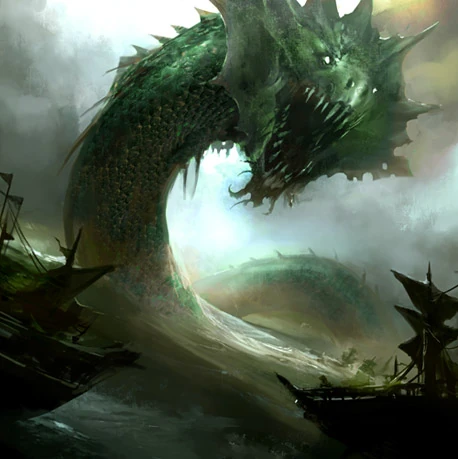
One of the monsters shown is an appropriate encounter. The others? Not so much
Gurps suggests adding HP and ST in accordance with the cube of weight. This is the scientificly correct way to do things, due to something called the square cube law. Of course, most giant monsters are flagrant offenders of the square cube law, and so I (and many others) suggest raising ST with the cube for most giant monsters. A third option is to use the damage from Cubic Strength and the HP from Square ST: this will give monsters that require lots of hacking away at but don't kill ships with a single blow.

The table below matches stats to sizes, with three entries for each SM. Note that individual monsters are likely to vary from the numbers given. Not that it really matters if a ST 120 monster hits your boat or a ST 125. The examples given to the side are conservative weights: Record holders, Boasting Anglers, and Film directors usually move the creature up a level or two, when they don't create another creature that looks like the original but is much bigger.


WeightSMShort LengthLong LengthCube STSquare ST
100 lbs01.5m2.1mST 90d+2ST 8.50d+1
150 lbs01.7m2.4mST 100d+2ST 100d+2
200 lbs01.8m2.7mST 111d+-1ST 121d+-1
300 lbs12.1m3.1mST 131d+0ST 151d+1
500 lbs12.5m3.7mST 151d+1ST 192d+-1
700 lbs12.8m4.1mST 171d+2ST 222d+0
1000 lbs23.1m4.6mST 192d+-1ST 273d+-1Big Bottlenose
1500 lbs23.6m5.3mST 222d+0ST 333d+2
1 tons24m5.8mST 242d+1ST 384d+0Record Squid
1.5 tons34.5m6.6mST 283d+-1ST 475d+1
2 tons35m7.3mST 313d+1ST 546d+0Great White
3 tons35.7m8.4mST 354d+-1ST 667d+2Orca
5 tons46.8m9.9mST 424d+2ST 859d+2Mausosaur
7 tons47.6m11mST 475d+1ST 10011d+0
10 tons48.6m12mST 536d+0ST 12013d+0
15 tons59.8m14mST 607d-1ST 15016d+0
20 tons511m16mST 677d+2ST 17018d+0
30 tons512m18mST 768d+2ST 21022d+0Humpback
50 tons615m21mST 9010d+0ST 27028d+0Moby Dick
70 tons616m24mST 10011d+0ST 32033d+0Megaladon
100 tons618m27mST 11012d+0ST 38039d+0
150 tons721m31mST 13014d+0ST 47048d+0Blue Whale
200 tons723m34mST 14015d+0ST 54055d+0
300 tons727m39mST 16017d+0ST 66067d+0Kraken
500 tons831m46mST 19020d+0ST 85086d+0
700 tons835m51mST 22023d+0ST 1000101d+0
1000 tons840m58mST 24025d+0ST 1200121d+0
1500 tons945m66mST 28029d+0ST 1500151d+0
2000 tons950m73mST 31032d+0ST 1700171d+0
3000 tons957m84mST 35036d+0ST 2100211d+0
5000 tons1068m99mST 42043d+0ST 2700271d+0
7000 tons1076m110mST 47048d+0ST 3200321d+0

Bulk is a defense in and of itself. Even if a creature has no natural armor, large animals can take a lot of damage by the simple fact that their vital organs are deep within them. Even an animal without natural armor should have DR at 1/10th of its HP. Additionally, targeting the vitals of such a creature is not trivial. Those wishing to target the heart, brain, or kidneys will need either a lot of penetration from their missile or a  sufficiently ridiculous stick to put a blade on. Adding another DR at 1/10th to attacks vs the vitals is appropriate.

On Aquatics

 One of the trickiest difficulties of a sea monster is that its in the water and you're stuck on a boat -- if you're lucky. Being alone in the water is even worse, unless you have some powerful technology or magic to back you up. Don't let the characters attack the monster whenever they feel like it, and most attacks can't be blocked or parried.

Sea monsters are generally more maneuverable than ships. They may also be faster, but that's true less often -- though you may have to run with the wind to outrun the thing. Most of the time, you don't go to the sea monster: the sea monster comes to you.

The water often forms an additional barrier against injuring the creature. The diffraction in the water gives a -4 to hitting something across the water barrier. Not a problem if you're a aiming for the main body, but if you're aiming for a place that you can actually hurt the thing, like an eye, it can be tricky element to add. And if launch the weapon in the water itself your arm will be impeded! Ranged weapons have greatly reduced ranges, and firearm projectiles will actually bounce off of water.

nothing visible underwater
Of course, That's once you spot the thing. The water forms a reflective barrier that makes it near impossible to see things far away. The angle is important.. you actually have a chance to see things coming up from under you -- but the distance is very reduced. Most of the time, you have to rely on spotting momentary surfacing  (which is usually not complete) or bubbles coming up from a surface creature. Fortunately, most of the time you just want the monster to go a way, and a lot are pretty obliging about displaying before they attack or coming to you to latch strait onto your ship. But exceptions do exist, particularly among leviathans, and a smart monster can use hit and run to great effect.

If you're serious about running a fight in the water, gurps pyramid 26 -underwater adventures, contains the rules for underwater fights.

On Being Monstrous

There are a number of shapes that show up in sea monster lore again and again.  The serpent, the kraken, and the leviathan (ie, really big fish shaped creature). There is a curious dearth of arthropods, probably because arthropods aren't open water creatures and don't get as big as the others.

Sea Serpents tend to be smaller than the ship. They also tend to either have main bodies impervious to most hand weapons, or to display only their head during an attack. 

One signature mark of the sea serpent is the head. Unlike the other two classic forms, The serpent can stick his ugly head up on board the ship and look you in the eye before he eats you. The head of a serpent moves across the deck of the ship monstrously fast -- it should have enough reach that it can strike most of the crew with them striking it. Attacking the serpents head requires ranged weapons, a sufficiently long stick, or acrobatics in the rigging.

The other signature of the sea serpent are its coils. In fiction, sea serpents are always coiling around the ships they attack. Their goal may be to crush the ship, it may be to drag it under, or it may be to just get a firm grip on the thing its attacking (which would actually a tactically sound idea if it was dealing with a leviathan).

The Kraken is a squid shaped monster. That is to say, it has lots of arms. It is common for fiction to not even bother giving a proper count on the arms. Battles with Krakens on the big screen often depict a lot of tentacle chopping. Realistically, this will end the battle pretty quickly -- unless you have the kraken with the improper arm count or a cinematic kraken. Of course, its usually only heroes who can cut through a tentacle. Be sure you know a kraken's goals -- If its trying to just grab the crew for a quick snack, it can be terrifying as it sweeps around tentacles, grabs three or four of them, and then disappears into the deep. Of course, Krakens in fiction usually try to sink the ship, presumably because they want to eat it.

The leviathan is at once the tamest and the trickiest of the forms. Its the truest to life, as evidenced by classics like Moby Dick (Ok, Jaws can also be considered a leviathan). A battle with a leviathan is a very impersonal thing. There is no eye contact, and the leviathan makes good use of the protection of the sea -- most attacks can be made without leaving the water. Of course, Leviathans don't usually float right under the boat and chew until their is a hole: Leviathan combat is about movement. They charge their targets, and its not uncommon for them to launch themselves right out of the air after an attack.

And sometimes the craziest monsters combine multiple forms. Such is fiction, nightmares, and crazy GMs. When I was a kid I gave a serpent a tentacled end, a shark head, and crab claws. When you do this, step back, and ask yourself what the thing is going to behave like. In retrospect, the thing acted much like a serpent -- a personal, face to face conflict based on picking off specific crew. So when you run into something really crazy, just ask yourself what it acts like. And its entirely possible for that kind of crazy monster to act like different monsters at different times.

There is actually a fourth archetype that may play into some sea monsters: the Dragon. which deserves its own article (and got its own book). In some ways, its an extension of the personal and armored serpent, but in other ways, its an extension of a land dwelling monster to the ocean. A similar thing can be said about the giant crab -- essentially a land monster in an aquatic environment.

Facing Down a Ship

A sea monster attacking a ship generally has one of three goals:
  • It wants to eat the ship
  • It wants to drive the ship out of its territory
  • It wants to eat the people
These motivations effect the way the monster fights.

It also important to remember that most monsters are dumb brutes that don't realize the advantages they have. The smart ones generally only have a few tricks that make them one step above animalistic, and don't tend to come up with new tricks. Of course, truly intelligent monsters are possible. Just don't be surprised when they become much tougher to defeat. 

Dragging it down:

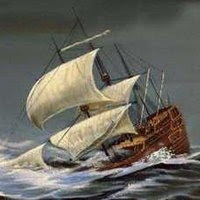
So often in fiction, the goal of the monster appears to drag the ship down into the water with it. Ships are remarkably buoyant, up until the point where they start taking water on the inside. It takes a great deal of strength to drag the ship all the way down, but merely tipping the ship over can be just as bad. Of course, most boats are built to intentionally be difficult to capsize. In most cases, the crew can do little to help the ship beyond clever tricks to give small penalties to the contest (likely -2 at the most), and fighting off the monster.

To drag down a ship, a monster needs a way to grasp it -- so serpents and krakens tend to do this the most. The point at which the monster grips the ship is important, as that's where the heroes need to focus their attack.

Ships are remarkably buoyant and stable -- those are pretty much the qualities they are designed for. They also won't fight back being tipped over with more than brute force -- which means you need a reasonable way to roll strength. B349 has rules on how to adjust the scores. You can resolves a monster trying to tip over or pull down a ship however you want, but remember the following:
  • Treating it as a grapple where sinking is a take-down takes a mere 1 second
  • Treating it as a grapple where tipping or pulling down is a pin will still be over within 10 seconds.
  • Ships are big. Even a monster capable of simply pulling it down will need time to move the ship the requisite distance.
  •  Attempting to pull a ship down is a great way to cause it damage. 
  • Attempting to pull down a ship may result in inadvertent tipping. 
  • The time to capsize is effectively a time bomb for your players -- it forces them to confront and defeat the monster quickly. Time the capsize accordingly
This is completely made up, but the following should be playable.
  • Find the effective strengths of the ship and the monster. 
  • Each round roll a contest of strength.
  • Each margin of success by the monster sinks/tips the ship by 5%.
  • If the ship is being pulled down, it returns to its place at a rate of 10% per margin of success. Its also appropriate to add the ships stability to this roll -- and to tip the ship if the stability bonus gives the ship the victory. Don't add the two numbers together -- track them seperately
  • Once 100% is reached, a tipped ship is on its side, and starts taking on water. It takes 5 minutes of work and a successful shiphandling roll at -4 (this may be a good place for a technique) to right the ship. The monster may attempt to just keep rolling the ship, which doesn't really change its
  • Once 100% is reached on a ship being pulled down, the ship starts taking on water. It keeps on resisting the monster's pull, though as water fills the ship, it will resist less and less. 
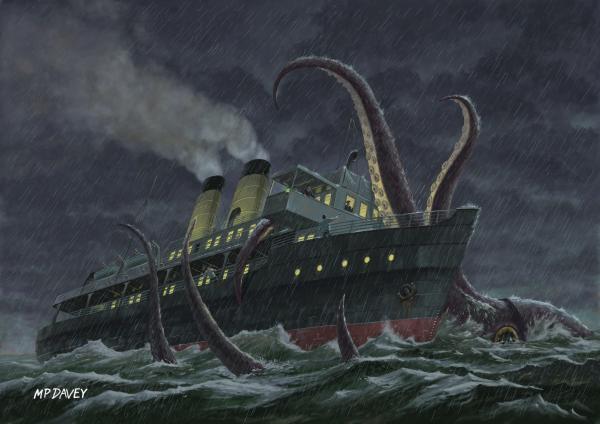
Is this a tip or a pull under?
The rate at which water enters the ship is highly dependent on the design of the ship -- the GM should decide on a rate.This method can and should be modified when need be -- changing the rates at which the contests of strength happen and 'percent capsized' can slow, speed up, or make more swingy the rate at which the boat goes down. Smaller boats should tip or pull down faster than large ones.

Sometimes a Leviathan will attempt to capsize a vessel (classically a smaller boat). This is not an attempt to drag down or tip the ship via grappling rules. The leviathan needs either a large ST advantage or persistence and a clever mind to pull this off. Model a single attempt like a fluke sending a wave or bumping the ship with the head as a take down attempt using half the ST score. A more involved attempt like amplifying the rocking motion of the boat takes longer (probably 20 seconds), but may be able to use the full ST score at the GM's option. Unlike a physical grapple, these actions DO give the crew a chance to react and fight back, but they will need to be aware of what's going on and ready to counter it to avoid massive (-4?) penalties to their rolls.

Breaking the Ship:

Leaks can happen through punching through the hull, but they can also happen due to internal stress. And sea monsters don't generally punch small holes in the ship: they squeeze it, ram it, or otherwise attack the grand structure. Monsters generally don't bite ships -- boats they might, but not ships. 

Despite the cannon ball problem  and the fact I often have problems with how slam and constricting damage work, this is probably one time when the rules on those three topics come out nicely. Alternatively, have the ship make HT rolls after each slam or 5 seconds of constriction or take an appropriate amount (10 percent?) of damage. Its worth noting that most underwater ramming attacks will take place with fairly long intervals as the creature rams, pulls away, and then builds up speed again. Impact velocity for leviathans is generally between moves 10 and 15. Additional DR should be given to a creature that intentionally rams, and especially one thats designed to do so (Orcas come to mind).

Using Sea Monsters

The sea monster fight is interesting because its almost obligatory to throw in once and boring to do it twice. Voyage of the Dawn Treader -- many monsters, only one serpent. 20 Thousand Leagues Under the Sea -- one giant squid. Dreamwork's Sinbad: Legend of the Seven Seas. Several different monsters, but only one counts as a sea monster as treated in this work. In Odysseus, we have two sea monsters-- who show up at the exact same time. Order of the Stick talks about fighting every aquatic monster in the book (literally, as befits order of the stick), but so far only ever shows one fight with a big aquatic monster (a summoned giant squid). There is a lot of precedence for fighting a giant monster once and only once. And if the campaign (or campaign leg) consists of nothing but fighting massive aquatic beasts, you run the risk of being boring.

Unless! your characters go into the game knowing that sea monsters are main foe and specialize as hunters of them. A crew of larger than life whalers hunting down killers that ravage shipping lanes, or  hunters of exotic creatures. This is because sea monsters by nature don't bring a lot of plot with them. They show up, terrorize a ship, and then go away. Additionally, it takes an odd set of skills to fight a monster correctly and most characters won't have that set.

But lots and lots of campaigns can use sea monsters as an added element. I hope this article gives you lots of ideas of what to add and how to handle the fight.

Monday, April 25, 2016

Cinematic Sword Play

Three minutes. when's the last game you fought for 10 rounds?
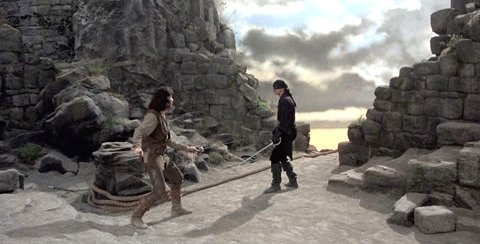
One of the great classics in cinema is the long drawn out fight. These fights consist of long, drawn out contests of skill, movement, and even conversation. They take minutes to resolve, not seconds. Gurps is notable for its speed of combat -- it happens very quickly in game time and rather slowly in real time. It is not suited for emulating, say, the duel from The Princess Bride.

And yet gurps should be able to do anything! It should be able to handle both quick combat and long and drawn out combat.

Wednesday, February 3, 2016

Costs ER as a Cost Reduction

My greatest frustration with 'costs FP' is that it reduces a set percentage of the ability cost, no matter how large or how small. This makes spending the FP for cheap abilities, like a minor attack, almost prohibitive in cost, while costs FP on something like jumper is nearly a point crock, particularly if you have lots of points to spend on an energy reserve. A lot of attention is placed on how small of a discount costs FP gives in the first place, but the real issue is that costs FP doesn't care about how many points the ability cost in the first place.

For example, Sardon half-demon has 3 levels of telescopic vision, but he has to draw on his unholy power to use them. This costs 3 ER. Sardon's ability is Telescopic Vision 3 (costs 3 FP per minute -15%) [13]. He only saved 2 points on this ability, which normally costs 15 character points. And he has to pay 3 FP each time he uses an ability he paid almost full price for. Elidoran the elf can slip between worlds, but it costs him 1 FP. His Jumper (costs 1 FP -5%) [95] is a solid 5 points under what he would have paid without spending FP. Is that price wrong? probably not, but Elidoran gets a 5 CP discount from spending 1 fatigue point while Sardon got a 2 point discount from spending 3 fatigue points. Its not worth it for Sardon. Why? because FP cost CP. Sardon's player and the fluff would like to just buy more ER to reflect growing closer to his demon roots. but it costs more to buy a single point of ER than to remove the limitation on telescopic vision.

This is a limitation on player concepts. They are told what they want to do is expensive, when it really shouldn't be. Its not about munchkinry, its about making wizards limited mainly by the energy pool viable.

Having identified this problem, I will now fix it:

Tuesday, February 24, 2015

How to stat an alien species

Coming up with the idea for an alien species can be tough, if rewarding work. But so often when you decide to give it game stats, it transforms from a 3-dimensional creature into a one dimensional upgrade for a character, or even worse, ignored because it isn't an upgrade! But there are ways around this. Ways that will even help refine what it is to be alien...

Friday, January 16, 2015

Splitting up IQ: Qualities

IQ is an extremely wide category -- it covers everything from building a boat to passing yourself off as someone else to solving complex math equations. This was fine when Gurps was a game about combat: it was the 'everything else' category. And in a game thats still overwhelmingly about combat, its still works fine. However, it struggles when it tries to focus on a game that isn't all about combat or other physical activity. The way this shows up tends to be in IQ being too cheap and IQ being too broad. A classical example is the wizard who has to sink lots of points into IQ to cast spells and then causally puts a single point into fast talk and becomes the de facto face man.

One of the first things to do in this situation is to start charging 20 points for IQ rather than 20 points for IQ+will+per, and to encourage talents. This was a solid effect of lowering general IQ, but keeping the specialities of the character intact. This is sufficient for a lot of concepts, particularly concepts useful to PCs. It breaks down after the talent reaches a certain size though: a 15 point talent is rarely competitive even with the expanded 20 point IQ -- though some do exist. This becomes particularly apparent when trying to stat very round characters (like a real life person).

My solution is called Qualities. IQ has been split up into six broad 'qualities' with a seventh that can spawn additional supernatural uses.