Monday, April 25, 2016

Cinematic Sword Play

Three minutes. when's the last game you fought for 10 rounds?
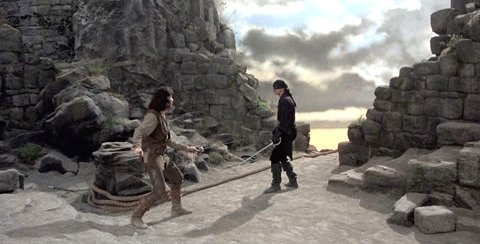
One of the great classics in cinema is the long drawn out fight. These fights consist of long, drawn out contests of skill, movement, and even conversation. They take minutes to resolve, not seconds. Gurps is notable for its speed of combat -- it happens very quickly in game time and rather slowly in real time. It is not suited for emulating, say, the duel from The Princess Bride.

And yet gurps should be able to do anything! It should be able to handle both quick combat and long and drawn out combat.

Thursday, April 21, 2016

Monster Hunters: Cononel Rush, Mad Scientist

I was playing around with Collaborative Gamer's Adventure generator using my rules for Monster hunters, and got the following plot idea:

Hook

A bunch of previously deathly ill and weak patients at a hospital go berserk, smashing equipment, trying to bite people, and making bestial noises.

The players may have to restrain the patients themselves, or they may arrive after they are all restrained (or dead). Investigation should reveal at least some of the following facts:
  • This is an Zombie Virus
  • Its not infectious, at least not via biting 
  • These symptoms are characteristic of zombies associated with one Colonel Rush, a mad scientist and rouge super soldier who has declared war on 'God'.
  • Colonel Rush seems to create zombies for some unknown purpose
  • One of the medical staff wandering around was faking his identity -- he looks like Colonel Rush
  • Each of the Victims had the same quasi-diagnosed symptoms
  • There was one more victim with the same symptoms -- and she's missing from the hospital
  • Colonel Rush took the girl
Further clues should lead the hunters on a chase to rescue the girl before the colonel dissects her or worse.

The Colonel

Built as a Techie with the criminal lens and the overman power up.
ST 13  HP 17
DX 14  Will 18
IQ 18  Per 18
HT 14 FP 14
Traits:  Injury Tolerance (unliving), Neural Computation Matrix 2, Cerebral-motor multitasking, Enhanced Time Sense, 3 gizmos, High Pain Threshold, Serendipity, Unusual biochemistry
Skills: Inventor!-19, Medic!-18, Tactics - 18, Weird Science- 17, Liquid Projector (Sprayer) -16, Guns (riffle) -16, Saber -13, Throwing-13, Acrobatics-14, Wrestling - 15, Acting-18, Intimidation - 18, Traps-18, Lockpicking-18, Urban Survival -18, Streetwise-18, Forced Entry-15, Driving -14 (and others)

The Colonel is a coward at heart -- this is a rescue and capture mission, not a fight mission. The guy is slippery -- perception rolls are typically all at 23 (ETS gives +5 if time is an issue),  Maneuvering him into a corner requires beating him at tactics, He's not bad in a fight, and he can steal cars, set or disarm traps at the drop of a hat, and he tends to be quite well equipped. Play him as a very prepared foe as well a very intelligent one -- he will always have an exit planned. He's also not afraid to take hostages to trade his way out of a situation.

The Colonel carries several aeresol spray 'bombs', filling an area with a chemical or biological agent. Some of these are duds! others contain nasty chemicals or biological agents. These aren't just thrown, he will also use them in traps. Unless specified, two successful resistances or a failure makes the target immune in the future.

Rage Gas: A biochemical agent that causes madness. Inhaled, HT-4,  10 second onset, failure results in target going berserk for a full minute. This can be used in a crowd to slow down hunters or loose himself in the chaos, but if he wants to hurt them, he'll need to get a champion to fail his HT roll.
Sleep Gas: Inhaled, HT-2, 10 second onset, failure results in unconsciousness
Zombie Spores: Inhaled, HT, 60 second onset, failure results in victim becoming unconscious for 5 minutes and then a slow zombie for 1 hour.
Placebo: Does nothing, but looks different and can be quite useful
Hallucinogens:Skin Contact, HT-4, 20 second onset, Hallucinating
Nerve Gas: Skin Contact, HT-6, no onset, 1d6-2 over six one minute cycles
Death Spores: HT-4, 8+1d*2 minute onset, 1d6 damage per cycle, 10 cycles of one minute

This is not the limit of the list. If you use this adventure feel free to come up with more ideas for his bombs.

Colonel Rush also uses zombies. If he is given an hour with a subject, he can turn them into a fast zombie that obeys his commands. If he is rushed, 10 minutes is sufficient to prepare a slow zombie or a fast zombie that doesn't follow commands at all!

Colonel Rush's file is not hard to get, but you do need to be in the know, and often people don't have time to grab gas masks before heading out to face him.

Friday, April 15, 2016

Adapting Collaborative Gaming to Monster Hunters

The Collaborative Gaming System is obviously made for fantasy, and skews that direction. But how hard would it be to run it with a different genre? Like say, Monster Hunters. I decided to go ahead and do that, and tell you guys about the modifications I had to make. The modifications are fairly large, but they are also fairly simple.
  • Adjust Monster Type Table
  • Treasure and Fame become saved lives and monster slaying
  • All Adventures start off as investigation, with starting clue
  • Solo 6 for What, Where, When, Who, and Why being obvious
  • How far is changed to 'how fast is the investigation take place'
  • 'Dungeons' are changed to 'Lairs' and 'Crime Scenes' (info areas)
  • Connect Clues with Lore Points
  • Peril and Monster Hunters Balance

Monster Type Table

One of the big obstacles is that the monster table given isn't appropriate. Of course, Monster Hunters has a fairly standard list of foes. These foes are different for each GM and setting: Fae may or may not be a big foe. You may or may not want aliens in your game. You may or may not want to come up with a mutant animal on the spot when asked to. Psi may dominate your game or not be included at all. You may have a full demi-human cast like Monster Hunters International or none at all. That said, as long as you know what you want, building the table is easy.

This is my own version:
                     1 2 3 4 5

Undead Spirit Living Humans Aliens
1 Vampires Rouge Angels Lycanthrope Rouge Crusader Greys
2 Vampires In Betweener Lycanthrope Cultists Nordics
3 Ghost Demons Lycanthrope Rouge Psi Alien Monster
4 Mummy Demons Mutant Animal Rouge Witch Reptoids
5 Zombie (Curse) Fae Legendary Creature Rouge Experiment Stalkers
6 Zombie (biological) Fae Custom Curse Campaign Emphasis Campaign Emphasis


On 6: Campaign Emphasis
Lycanthrope: 1-2: wolf, 3: eagle, 4: bear, 5: tiger, 6: random animal
Alien Monster: 1:Insectiods, 2: Phasites, 3: Devourers, 4: Disease, 5: Create New, 6: Campaign emphasis
Legendary Creature: Use chupacabra if you need stats premade. Or get creative and pick yetis, lake monsters, a dragon, or your local legend
Custom Curse: This is a curse on a creature or person.  It should be considered a 'living' creature.
   
The four campaign emphasis options should be picked at the start of the campaign: they show what is emphasized in this campaign. It doesn't have to be a new category, but it doesn't have to be an old category either. An entire category of 'curses' or 'demihumans' could be added. Rouge humans could be another Witch or Psi, but it could be Men in Black or a mad scientist. At this stage also prune what you don't want, and replace it with options you want to emphasize. Perhaps all psi is replaced with magic, or perhaps you don't want cultists.

Further, You should always roll on this table when picking a villain -- but don't roll on the table until you have clues that tell you what the monster is, or what its 'appears' to be. This table may very well come up more than once for a single hunt!

Treasure and Fame: Lives and Slaying

Monster Hunters don't fight for money (ok, some do, but they're exceptions) and they despise fame: it endangers the secret. They want to save people and to kill monsters. So on the rewards table replace 'rates' with 'lives saved' and Social points with 'Monster Killing': instead of Standard Rates with Fame and Glory you have a moderate number of lives at stake with the opportunity to kill an exceptional number of monsters.

Starting Adventures, or should I say Hunts

On finding Adventure, Monster hunters generally have trouble come to them rather than the other way around. The initial clue, the inciting incident, isn't just scene dressing -- its an important part of the investigation.

1:You notice a odd behavior or a monster
2:Someone is dead
3:a monster attacks a player
4:Research yields behavioral clues
5:Someone else notices an odd behavior and tells you
6:Mystical Means

Don't roll up the adventure type until you know what its going to be: the majority of monster hunter adventures start with investigation. You have five things to figure out: What, Where, When, Who, and Why. At the start of an investigation, roll the solo 6 for each, asking 'is this obvious?' This doesn't mean the answer is correct, just that it appears this way. Investigation is required to confirm each, at which point, you roll the solo 6 again to see if the fact was true...

The adventure type table is also a little skewed towards Fantasy activities and away from monster hunting ones. In particular, compete and explore tend to be rolled a lot more than your typical monster hunters would want, and we want more emphasis on investigate. Change compete and explore rolls of 5 or 16 into investigate rolls (about half of compete or explore quests become investigate adventures).

Distance and Time

The distance category is technically measured in 'Units of Time to location', but this can be tweaked to represent how easy the investigation is to follow: and as a consequence how long each step of the investigation can take. Actual distance may be involved as well, but the most important measure is the dominant unit of time.

Its also probably a good idea to increase the sense of urgency at the lowest level: Change "No Particular Rush" to "People die, but at a category one slower than expected, and it won't go away with until dealt with".

Dungeons and Crime Scenes

Monster Hunters don't really do journeys. You have special skills that let you find the danger, you don't encounter it just wandering around. The way they do dungeons is also different, but surprisingly similar. Most Dungeons are a single area: Usually a crime scene or a monster lair. Roll for the entrance if there is a chance of hostiles. Be creative about the word 'guarded': it could be a lock, could be a ward, could a security alarm. Or actual guards. When rolling for opportunities roll on the 'best' category of 'safe', 'info' or 'lair'. When rolling for mishaps, choose the least dangerous option that makes sense -- monster hunters don't do a lot of combat.

Dealing with Clues and Lore Points

Lore points are of especial interest: They are good for a +1 clue that you wouldn't have expected at the scene. Bad guys make mistakes! Roll on the table for what kind of tip was left.

1: What 2: Where 3: When 4: Who 5: Why 6: Player choice or other useful info

If the category has already been solved, treat it as a 6, and choose what kind of a clue you need.

When selecting clues, come up with an 'apparent' adventure. Why clues can be inspired by adventure types. What clues use monster types. Who clues use random pieces of NPC. When Clues use the 'What's the rush Table'. These are mined for little bits and pieces, though players should feel free to use the solo6 to confirm or disprove theories before rolling for completely new data.

Peril and Balance

The peril system isn't quite as applicable for Monster Hunters -- and sometimes you'll get responses like 2N rouge angels -- what do you do then? Well, you do your best. Let peril make things harder or easier without changing the stats

In Summary

I hope you enjoy this. In some ways, its can aid in GMing as well as in solo or collaborative play. I goofed around and quickly generated a couple of fairly interesting monster hunters plots. The system is really good, and as you can see, not really that hard to adapt to monster hunters. Happy hunting!

Wednesday, April 13, 2016

Collaborative Gamer's Adventure System

Click to expand and view by itself

Collaborative Gamer has been busy making a system for running a game without a GM. Previously, I've been sitting to the side and just taking a piece here and there of his work. I was disappointed at the fantasy and particuarly the dungeon fantasy bent it was taking. Then he started running a solo adventure with his work, the adventures of Tamien Fell.  On week 6, I finally read through an adventure, and realized just how much I'd missed.

The system focuses on information management, and is a jungle gym for both the world builder and the story builder. It gives pieces, suggestions, and twists, and then asks you to tie it all together yourself. Its designed to generate plots left and right, and so far, it doesn't seem too bad.

The hardest part is how to string it all together. How did he know when to roll on a given table. And so I built a diagram that sums it all up.  A few things to remember:

  • The four boxes at the top are always appropriate to bring in: they drive the plot and the world forward. 
  • Always be on the look out for adventure types! Each "Adventure" is really more or less a single task. You'll find yourself spontaneously generating them yourself. If you don't notice the adventure, you can't roll for plot twists
  • Only figure out what the characters know. This is key to making this system work. The system is designed to provide suspense, not fleshed out plots -- at least not until the end. And thats a feature, not a bug.
  • Feel free to drop or fill in details. If you know what the type of adventure is, that's fine. If you don't want to worry about dungeons, then don't.
  • This is as much a GM game as it is a player game: in some ways, its having your cake and eating it too.
The system is easily tweaked to provide for other kinds of games: Action, Monster Hunters, and space opera may need some tables expanded, but the actual adventures should roll along just fine. I may do one myself as a proof of concept.


I hope you enjoy collaborative gamer's work!

Friday, April 8, 2016

The Refuges: Introduction to Riask


Gravity always wins.  The world is in constant flow. Where ever you are, you are always on a hill, and there is always a slope. And it is always raining. Welcome to Riask.

The Shape of the world

Riask is neither a round world nor a flat one. Its surface is shaped something like a funnel. The closer to the center one gets, the steeper the ground is, and all water flows to the central ocean. This ocean isn't emptied by anything so mundane as evaporation -- There is some sort of portal effect that drains the ocean into the sky. Sages claim that its not actually a portal and its just the way the world is shaped, but eventually just throw up their hands and settle for people calling it a portal.
Riask's ocean dumps directly into one of its two suns. The suns are small and similar to those one would find on a flat world-- glowing balls of heat and light with no discernible source of power. The first sun vaporizes the incoming oceans, complete with its dirt, fish, and anything else that may be in it, and form Riask's cloud cover. Riask's weather is mostly about variations on constant light rain. In fact, it doesn't have a day-night cycle either: just perpetual overcast skies and temperatures that fluctuate based on cloud cover.

Riask seems to be surrounded on all sides by solid stone. Sages are not sure if this is just the way the void makes itself manifest, or if the stone actually exists. Those who deal with it, usually under a lot of silt, know that its quite hard, but can be mined, and doesn't pull any silly tricks like reforming after its dug at least not on any time scale that matters.

The funnel and the suns create five grand weather zones on Riask: Ice, Spring, Tropical, Waterfall, and Ocean.  

The Magic

Riask is the home and center of Vasic Stone Magic. The stones themselves are cut from the foundation of Riask itself -- the black substance is considered by them to be the foundation of the universe. Getting the stone is not easy: the stone is very hard, and in most places found only under a thick layer of sediment and water. Riask's water table is quite high, and the only places where it is naturally exposed are on the cliffs of the waterfall zone.

Vasic Stone Magic includes teleportation. This is core to what Riask is, and prevents transportation from bogging down in the pouring rain and perpetual slopes.Vasic magic touches every part of the civilization of Riask.

Other kinds of magic don't work as well in Riask, though 

The People

Riask is fairly densely populated, at least in its center -- its a relatively small world with not that much living space. The great cities of Riask are almost all located in the waterfall zone, where the foundation stone is exposed and transportation via Vasic magic (both in world and off world) is cheap. The summer zone is also densely populated with food growers (especially rice), though civilization trails off in the spring zone. Goverment types also vary by zone: the great cities tend to have councils elected by those above a certain wealth line, while the summer and spring zones have a more feudal build. Riask is not politically unified, but it does have a certain cultural cohesion.

Riask is mostly inhabited by humans. They've come to riask in several waves, and have made themselves at home. Other species can be found in its great cities, but the country side is overwhelmingly inhabited by humans and the local Mugraggle. The Mugraggle are thin, spindly humanoids at home wading in water. They don't handle dim or bright lights well at all

Mugraggle [0]:  terrain adaptation (Mud, halved effect-50%) [3], Night Blindness (Mugraggle +0%) [-10], breath holding x2 [2], +1 swimming move [5], night vision 1 (brightness penalties) [0]

Murgraggle night blindness doubles the -1 from full day light as well as darkness penalties. On Riask, this is a much smaller problem, as the amount of daylight is constant. Campaigns set solely on riask may halve the cost of this disadvantage. Mugraggle form approximately 30% of the population of Riask. They are generally lower class, though some have risen to high rank, particularly among their own people.

Fauna

Riask is an ideal home for amphibians, and they abound, from giant crocodilian forms to  near-fish to grazers and burrowers. Its also home to a number of aquatic mammals, and a abundance of freshwater crustaceans and snails -- the moist climate is friendly to gilled invertebrates. Flying creatures are rare, at least on the floor of riask -- the ceiling (watered by dew rather than rain) is said to have an abundance of creatures.

More is coming

I hope you've enjoyed Riask so far -- but this is just the start. Riask is the 'default homeworld' for the refuges setting, as it has fairly cheap transportation to other worlds. You'll see a good deal more of this world. Also, this was the original setting Vasic magic was designed for, so all of that information is already out there.  Welcome to Riask!

Mystral Blooded

At long last we get human interaction without all of this glass in the way. Mystral blooded generate, store, and use mystral energy without any of the technology.

I'm not going to cover how to price these folks outside of a mystrally capable society: their abilities are very much tied to the prevalent technology, and priced as such.

The old mages of mystral realm had their innate talents mastered, cast in glass, and distributed to whoever could pay. Their feats and talents are no longer in high demand, and they have fallen from the power they once wielded. Of course, that doesn't make them useless. The Mystrally blooded can still interact with the technology, and can use it in ways others cannot. They carry around extra energy with them, and can circumvent technological barriers. The Mystral blooded excel most in the shadows -- a large proportion of them use their abilities in fields that that adventurers frequent.

Core Traits

Mystral Blood [5] You can produce, store, and use Mystral energy without the aid of technology. You produce 200 gems a day, and can store 5,000 gems of energy in your body.  You also have access to a number of perks and skills that allow you to replicate mystral technology. If you wish to sell the energy, you can generate an extra $120 a month.
Extra Generation [+20%/level] You produce more gems per day than normal. each point grants 200 more gems/day. This is limited to 9 levels.
Extra Capacity [+20%/level] You can store more energy than other mystral blooded. Each level raises the maximum storage by 5,000 gems. Limited to 9 levels
Replicated Devices Perk: For the cost of a perk, a mystral blooded may imitate the effects of a single mystral device. They must pay the full energy cost, and succeed at a Ritual Magic (Mystral) roll. failure results in the energy being spent as a great deal of light and noise. Valid Devices include: standard and dark specus**, any Comnus, Standard Thalmus* (at -2 to all rolls), Small and Standard Forge, hover ships up to 5 tons (must be on board), image disk+ Basic Amplus or Hologram Maker, Basic and Large Amplus, Menmus (-2 to all rolls)**, Automonton Menmus (-2 to all rolls)**, any hand held mystral weapon (one point per weapon, cannot quick fire, max acc 2)**, or a DR 20 mystral sink (doesn't stack)**.
** Requires a license perk, legal enforcement powers or high status
Ritual Magic (Mystral) IQ/VH: The skill of manipulating Mystral energy, a roll is required every time a replicated device perk is used.

Registered Weapons

The mystral blooded are walking tools, and in many cases walking weapons. The ability to walk around with their abilities is a legal boon. Whether or not their status is formalized depends on the exact setting, but they are considered to have the appropriate legal enforcement powers for what they can do, and should pay accordingly. If the powers are not formal and occasionally cause legal issues, add limitation: 'de facto' -40% to legal enforcement powers, or take secret if using them will bring down the law hard on you. In some cases, high enough status or rank can waive this requirement. Other times, a simple license perk will suffice.

If you are a well known Mystral blooded without a good deal of government trust, you will be watched, as you are a known risk. You will not be harassed, but  guards tend to be on alert around you, extra precations are taken, and so forth. This is the equivalent of a -20 enemy who is just a watcher, for a base of [-5]. The frequency of appearance is based on how often precautions are taken against you.

Social Standing

The mystral blooded are generally highly regarded by the societies they live in. In many settings, they form the core of the nobility, or at least having noble blood and mystral blood are correlated. The mystral blooded should purchase social regard in many settings. Whether they are feared, respected, or venerated is fairly setting dependent. If the mystral blooded have social regard in a setting, it must be purchased along with the core advantage. This may be sufficient to satisfy the registered weapons clause.

Sample Mystral Blooded

Marcus Axrell [100]
attributes [60]
ST 10 DX 11 [20] IQ 11 [20] HT 11 [10]
HP 10 Will 11 Per 11 FP 10
Speed 6 [10] Move 6
Advantages: [15]
Mystral Blooded (Extra capacity 3,200/day, 20,000 max) [8]
Replicated Devices ( Heavy Scorpus Arcus, Spectus) [2]
Social Regard (Feared) [5]
Disadvantages [-5]
Enemy (Guards, Watcher, 9 or more) [-5]
Skills [30]
Saviore- Fairre  -12 [2]
Ritual Magic (Mystral) -11 [8]
Beam Weapons (Arcus) - 13 [4]
Mystral Operation (Medical) -12 [4]
Mystral Operation (Surveillance) - 12 [4]
Fast Talk -11 [2]
Acting - 11 [2]
Climbing - 11 [2]
Running - 11 [2]

Marcus is an agent for hire. Born to a noble line that's run out of money, he's learned how to manipulate the energy that flows through him to see through to places he shouldn't, and to kill even after being disarmed.

Mystral Blood in Times of Crisis

Those with mystral blood technically can't do anything unique. Of course, others have to carry around expensive, heavy, and fragile equipment in order to replicate those feats, and are obvious when they do so. The Mystral Blood advantage could alternatively be bought as 10 levels of payload (gem block only) plus a point of signature gear and of independent income.

Mystral blood works best in times when stealth is key: they can walk through security check points with flying colors, then start blasting away or even messing with people's minds. They're also very useful to have when you don't want to carry a 200 lb thalmus around with you. And its really useful to not have to reload until you've expended 20 times the shots as everyone else.

The key to countering a mystral blooded is knowing that they are there. Societies that routinely deal with them usually don't bother to disarm people, and like to know the backgrounds of the people they invite over for dinner.

Its entirely possible to build a setting where mystral blood is quite common but still the only way to use mystral technology. In such cases, only those with the blood should have to pay for the ability to use it!

Its worth pointing out imitating a forge allows one to have TK over objects after focusing energy into them for a while. 

I hope you've enjoyed this treatment of how to work inherent magery into a magic as technology system. Have fun blasting away!

Mystral Automotons

One of the core technologies of Mystral Energy is the automatons: mechanical semblances of animal life that perform manual labor. This is a runaway technology that builds upon itself, and one of the core reasons that Mystral Energy is considered TL4+2^. Automatons can be found throughout Mystral societies, laboring away at their tasks.

Automatons use mystral energy very efficiently: something about the animal form cuts down on the energy used. Automatons come in all shapes and sizes, from lumbering hulks with eight legs and beetle-like 'mandibles' to three foot imitation people. The constant is limbs: the heart of Automaton movement is its legs and arms.

Appearance and Function

Automatons are largely made out of wood: glass is too fragile and metal too expensive for the purpose. Of course, the wood is often reinforced with metal, and the joints must be made of wood and metal. The Mystrium that powers them is worked into their frame, and shows as lines of inlaid metal in the wood.

The mind of an Automaton is stored in a complex glass ball. There is both a hardware and a software component, and both are difficult problems. While up to IQ 8 can be achieved, doing so is expensive, and when possible, Automatons are left essentially as dumb creatures. The 'eyes' of the Automaton (which also function as ears) must be patches of the glass brain left open to the world, which has lead many to conclude its best to just go ahead and give the things proper heads. In addition to eyes, Many Automatons, especially the less complex ones, have control patch on the brain.

Creating the mind of an Automaton is done with a machine similar to the Menmus, but that only works on automaton minds. The mind of an automaton is much better understood than a human mind, and its mostly programmable. And the actions should be treated as just that: programs. An ordinary operator is limited to copying programs painstakingly designed by an engineer, though turning off any given program isn't too hard, as is changing the 'ownership' of the automaton.

Automatons have the automaton and machine metatraits, Maintenance (monthly, 1 person) [-2], reprogramable, cannot speak, and are mystral-null. They can only learn mostly physical tasks.  They have been set to work farming, working textiles, and other repetitive tasks.

Minds

While the mind of an automaton can be changed after it is built, the hardware of the mind determines its general capabilites: you need much more complex brains to run the complex minds of a dexterous Automoton.

Mindless : The automaton does not respond to outside stimuli at all, but simply performs a pre-defined task. They can be manipulated via placing a hand on the control patch (a part of the brain) and giving commands like 'stop', 'start', and 'turn left'. IQ is 0, as are will and perception. They also have indominable -- they respond only to commands on the control patch. What a mindless automaton does can hardly be called a skill, but roll vs 8  if there is a chance it will fail at something related to coordination. $100, LC 4

Bestial: The automaton can see, hear, and respond to commands. They can move intelligently, search for things, pick up objects, and protect themselves from danger by moving away. They generally require supervision when doing something like plowing a field. IQ is 5, will is 10, and perception is 8. They have DX 8, and  Ham Fisted 2 if they have manipulators at all. They lack indomitable and are programed to obey certain commands (and sometimes certain people), but many of them still have control patches. Bestial automatons can be programmed with 4 skill points. $250, LC 4

Dexterous: Something of a misnomer as the greatest difference is that of intelligence, Dexterous automatons can perform complex tasks like sewing clothes, harvesting crops, building houses, cleaning floors and making sure soup doesn't burn. Dexterous automatons can have DX 9, IQ 8, will 10, perception 9 and and 12 skill points. They are limited to skills that don't require complex decision making. While its traditional to build dexterous automatons in a human shape, its not necessary. They are the least likely to have their control patch exposed to the world. $3000, LC 3

Bodies

There are many types of automaton bodies -- far more than there are minds, and its simpler to design new ones. Virtually every shape found in nature and few others are represented. Despite this, some shapes dominate. The primary determiner of cost is size:

ST 5SM -3$500
ST 7SM -2$500
ST 10SM -1$600
ST 15SM 0$1000
ST 20SM 1$1600
ST 30SM 2$3600
ST 50SM 3$11,000
ST 70SM 4$28,000
ST 100SM 5$100,000
ST 150SM 6$460,000

Automatons smaller than SM -3 are possible but still cost $500. SM 5+ automatons are limited to the water or air, as they are unable to support their bulk on land. The most efficient results (in terms of cost per pound of lift) come from machines in the ST 20-30 range, though 15 and 50 are within 10% of that.

Beast of Burden: A slow plodding automaton with  no limbs other than legs. +20% ST, Move 4
Mount: A faster automaton made for carrying around people. They tend to be stylized to look elegant, and  Move 6, Enhanced move 1
Beetle:Slow and plodding, but with a limb or two on the front. This may look like a beetle, but this design includes things similar to an elephant, centaur, crab or bear Move 4, enhanced move .5.
Quick Beetle:As the beetle, but faster: Move 6, enhanced move .5, + 20% cost
Scurrier: A lighter design meant for climbing, rough terrain, and moving sideways. Classic designs look like spiders or dogs.  +1 SM, Move 6 and terrain adaptation
Manual Scurrier: a scurrier design with hands that can perform useful tasks. +1 SM, Move 6, terrain adaptation, +20% cost.
Sessile: A legless device consisting only of manipulating arms. This includes crane-like structures, factory workers consisting only of the upper body, and other stationary automatons. -20% cost.
Humanoid: Built in a roughly human shape. Move 5
Slender Humanoid: A humanoid shape built for reach rather than strength. usually built in ST 10 size. +1 SM, Move 5
Ichthyoid: Built to operate in the water, via means of flippers or a fish tail. Move 4, +20% ST
Fast Ichthyoid: As Ichthyoid. Move 6, enhanced move 1 (water)

Other forms are possible, but less likely. Wheeled forms are particularly inappropriate. Most new automaton forms have a slight form change or improvement: a cutting edge model may have high manual dexterity 1 and cost 50% more, or be designed with an unusually smooth gait and cost 20% more.

Common Combinations

Servant: ST 10 Dexterous Slender Humanoid, $3600. Used to fill the roles of servants, mopping floors, doing laundry, and pouring drinks. An additional $100-$300 is often spent to have them made look stylish, with elegant guiding or an imitation of a human face. Skills include savoire faire (servant) and housekeeping.
Laborer: ST 15 Dexterous Humanoid $4000. Used in construction, farm work, pottery, freight loaders, and possibly as soldiers, Laborers are among the most common Automatons available. They have a variety of skills.
Big Beetle: ST 50 Bestial Beetle $11,250. These massive machines are the equivalent of forklifts, back hoes, and other heavy machinery. The two massive mandibles are incredibly strong, and the design is meant for moving lots of heavy objects quickly.
Mystral Horse: ST 30 Bestial Mount $3850. Sized like a biological horse but stronger, the Mystral horses can be ridden, but is more often used to pull carriages.
Builder: ST 30 Dexterous Beetle. $6,600. With six legs and the ability to walk on the back four, builders are usually used in construction tasks where delicate manipulation of large bulk is needed.

Using Automatons in the Campaign

Automatons are mostly meant to be used as a background element for a campaign, a technological nicety to allow drudgery to get done. They have their greatest impact on the setting in industry, transportation, and flavor.

Automatons could conceivably be used as soldiers, but they have a few major drawbacks. First off, they are mystral nulls, which means they cannot use mystral energy weapons or even mystral blades. Secondly, their skill with a melee weapon is generally limited to 11. You spend 8 points to raise it from DX 9, and the other four are generally required for other skills (like soldier). Lastly, Automatons are reprogramable. They do have major advantages though. They are manufactured, not born, and are when compared to a human soldier, pretty cheap. They can be built stronger than humans, are more durable, more obedient (unless your foe has gotten to them), and don't require food. Whether or not to use automaton's as soldiers is an important game decision, and can be justified in either case. Of note are wars against non-mystral foes, where automatons tend to be a lot more powerful. Regardless of whether or not they replace grunt soldiers, automatons will be used in war to carry things around, build fortifications and in other supplementary uses. And even if they replace the grunts, humans will need to be around to direct the troops, provide mystral support, and so forth.

Automatons are not meant to be purchased as allies or played as characters, but a group wishing to do so is advised to add another mind type with a higher price tag. This will turn the game into a full-on robot setting, with all of the implications involved.

Automatons are intentionally cheap: The laborer can be purchased for 10 months pay of the struggling TL 4 worker he replaces (automatons are mystral null and thus can't use most of mystral tech). If a setting where Automatons do not completely dominate lower-class industry is desired, Prices should be substantially raised.

I hope you find these low tech robots fun to play with and intriguing. If nothing else, this can serve as a base for you to start your own changes. Have fun playing!